
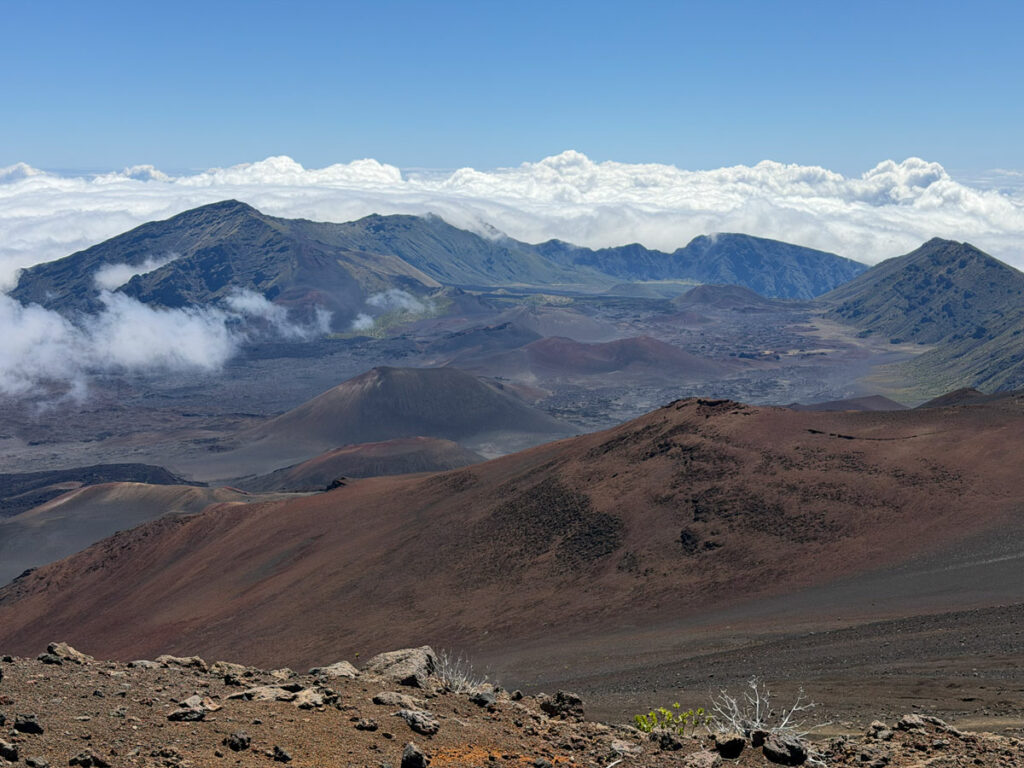
Haleakalā Crater
TRAIL STATS
Backpacking Hawaii’s Haleakalā Crater is an otherworldly journey that takes you across the crater of the ancient shield volcano that created the island of Maui. From towering cinder cones and colorful layers of ash, to lush Hawaiian landscapes, ocean views, and the place where the rainbow ends, there is enough here to delight and amaze you at every turn.
Trail Description
If you’ve ever gazed into the depths of Haleakalā Crater, you know it can feel like you’re on another planet—its mesmerizing shapes and colors leaving an indelible mark on your soul. My first time visiting the crater was an almost spiritual experience, richly satisfying to my senses, yet leaving me wanting more. That’s how a backpacking trip across the crater ended up on my bucket list. Fortunately for me, it was on my friend’s bucket list, too.
The pictures I saw prior to my trip weren’t particularly inspiring, nor do I expect my pictures to be any better. There’s just something about being there in that beautifully desolate place that stirs the imagination. It’s magical.
Our Route
To cover most of the crater, we chose a route that would take us from the summit area across the entire crater to Palikū, then over to Holua, then out on the final day. We figured this would cover around 20 miles, and we would have time to explore some side trails if we wanted. Tops on our list: the Silversword Loop and the lava tube.
The first order of business was to stop in at the summit visitor center and have a short chat with the ranger. He had us sign in and leave our rental car information in case of emergency, although the permit did not specify that we had to check in. Hurricane Lala had just come through days before, so emergency evacuation procedures were fresh on their minds. We asked him about water availability, and he confidently assured us there would be water. Since the campsites rely on rainwater catchment, always check with a ranger if you’re not sure.
Car Shuttle
If you’re going to do the same route we did, you’ll need to park a car at the end of the hike or plan to hitchhike when you get out of the crater. We wanted to have the car ready for us when we finished, so a couple of us drove the car down to the Halemau’u Trailhead and then hitched a ride back to the Sliding Sands Trailhead. Luckily, the park knows a lot of people will be doing this (even day hikers), so they have a special pullout on the highway for hitchhikers to thumb a ride.
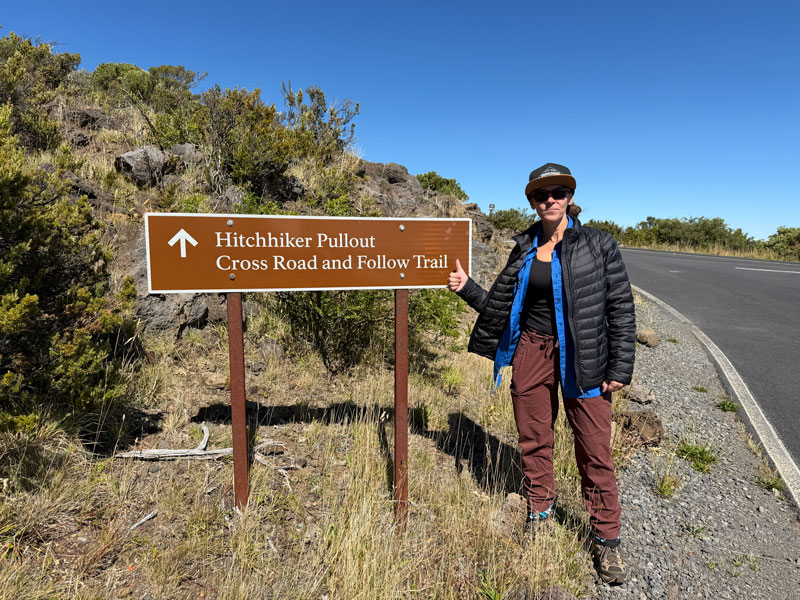
It only took us three cars to get a ride, but at the end of our hike, we saw a lot more hopeful hitchhikers, so we were glad our car was already there.
Sliding Sands Trail (Keonehe‘ehe‘e Trail)
Once back near the summit, we started off on the Sliding Sands Trail, which starts just southwest of the summit visitor center. The trail does have a Hawaiian name that I can’t even begin to pronounce, so I’m going to refer to it by its nickname “Sliding Sands.” There is a small 10-car lot near the trailhead where they prefer you park if you’re leaving a car up there.
Considerations for the trail
Going off trail is prohibited The ecosystem at Haleakalā is fragile, and going off trail not only scars the landscape, but also damages the soil and plant roots.
There is almost no shade anywhere Due to the lack of vegetation and the fact that you have to stay on trail, you will probably not find any shade at all. Because of the high elevation, the UV light is strong and can sunburn easily. Bring ALL the sun protection, including lip balm with SPF (I found this out the hard way when my lips looked like they were injected with filler after the trip).
Starting off on the trail, you’ll have awesome views of Haleakalā Crater almost immediately. Stop and take all the pictures you want because these are some of the best views you’ll have for the entire trip.
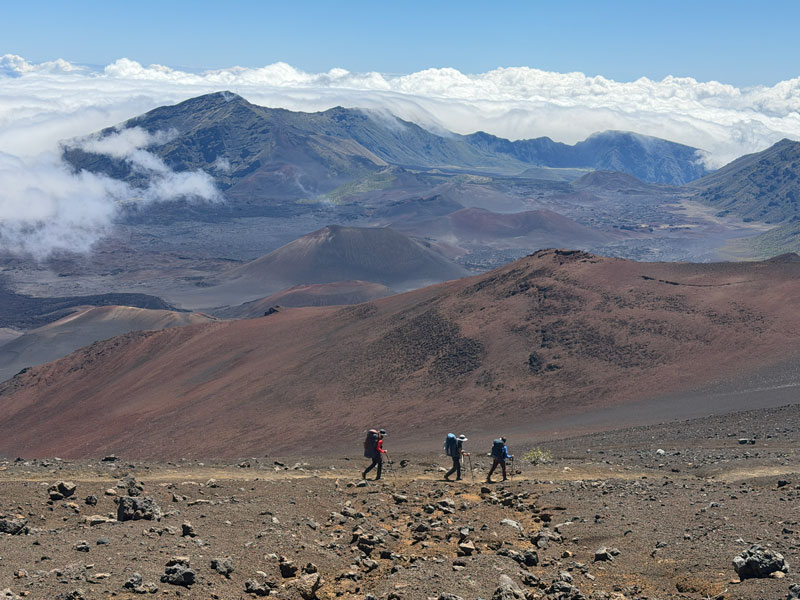
Though it’s called Sliding Sands, the trail is more like gravel and not too deep here. There are a lot of day hikers on this section, so you’ll definitely be sharing the trail. Those day hikers are gonna be so jealous of you because once you get a glimpse of this incredible place, it’s hard not to want to stay and see more.
Silversword Plant
A little farther down on the trail, you’ll see several examples of the endemic silversword plant that grows nowhere else on Earth. Its sharp leaves resemble swords and the tiny hairs on them shimmer in the sunlight to protect the plant from UV rays. Once in the silversword’s lifetime, it uses all its energy to produce a giant, flowering stalk and then dies.
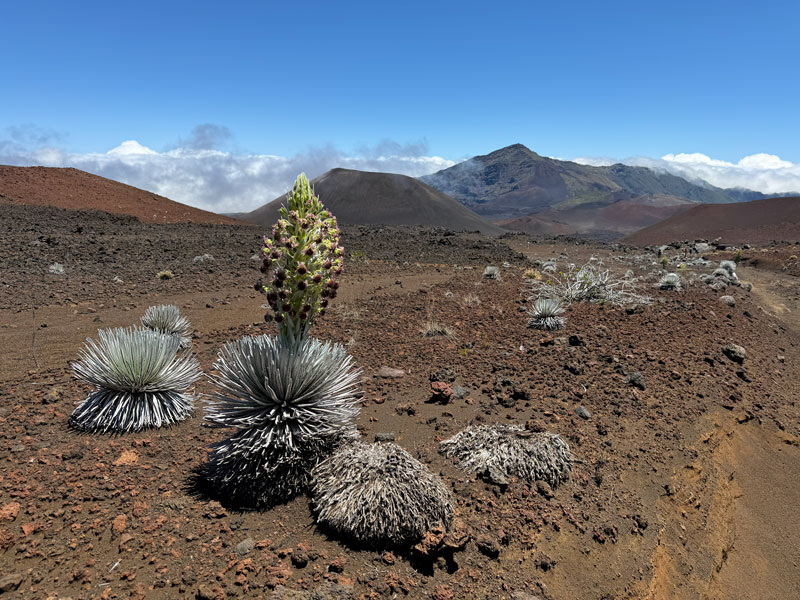
If you’re lucky, there will be a flowering one near the trail where you can get a sniff of the wonderful smell of these plants. The one we found was around 5 feet tall, so no squatting required.
Bottom of Haleakalā Crater
The Sliding Sands Trail takes you to the bottom of the crater around 4 miles in. After that point, the trail flattens out considerably, the sand deepens somewhat, and a little bit of vegetation appears. I say a little because you’ll still be hard pressed to find any shade, although we did manage to huddle right next to a small bush for a sliver of shade during lunch.
There are a couple of trails that branch off to the left, which day hikers were using to make a shortened version of the route we were doing. We asked the ranger if any of these trails were worth a detour, and he said no, so we didn’t bother to explore them. If you know something we don’t, let us know in the comments!
At every junction, keep heading to Palikū!
Kapalaoa Cabin
At around 6 miles in, you’ll encounter the Kapalaoa Cabin. We met some nice guys at lunch who were staying at this cabin and let us come inside to see what we were missing. Not only did they have a roof, a kitchen with a stove, beds with mats, and a large table, but they also packed a decadent meal of steaks, corn bread, and a charcuterie board. What?!?! We tried to trade our Mountain House meals, but no dice.
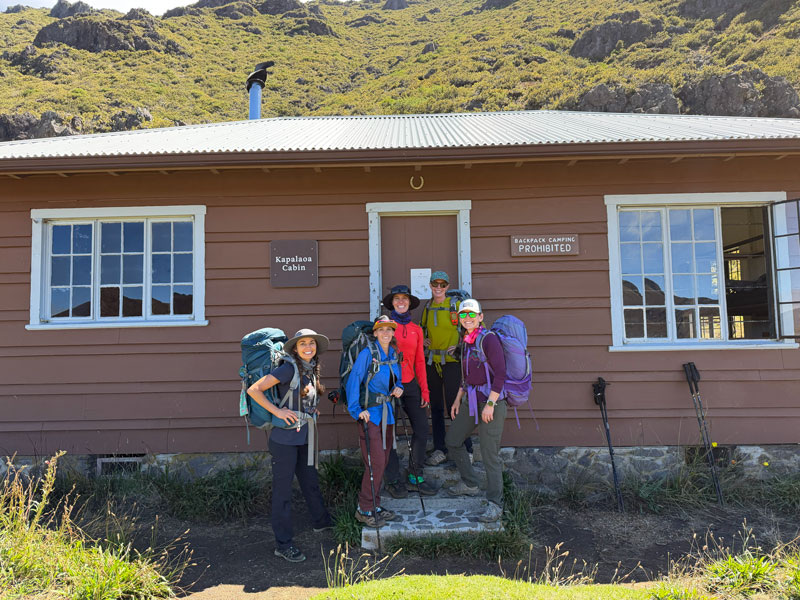
Just to rub it in, they have this nice big sign on the cabin that says backpack camping PROHIBITED. Move along, you peasants.
The guys promised us we were in for a real treat at Palikū, and we weren’t sure if they were just trying to get rid of us or if it was truly “the best campsite in the world.” Only one way to find out, so we pressed on.
There were about two more miles of flat, sandy trail before the trail made a marked change to sharp lava rocks, more shrubs, and a descent toward Palikū. Since Palikū means tall cliff in Hawaiian, when we saw some towering, green cliffs in the distance, we figured we were getting close. We were right.
Palikū
I don’t know if I would have called it the best campsite in the world, but I do have to admit it was beautiful and the only time I’ve ever seen where the rainbow ends.
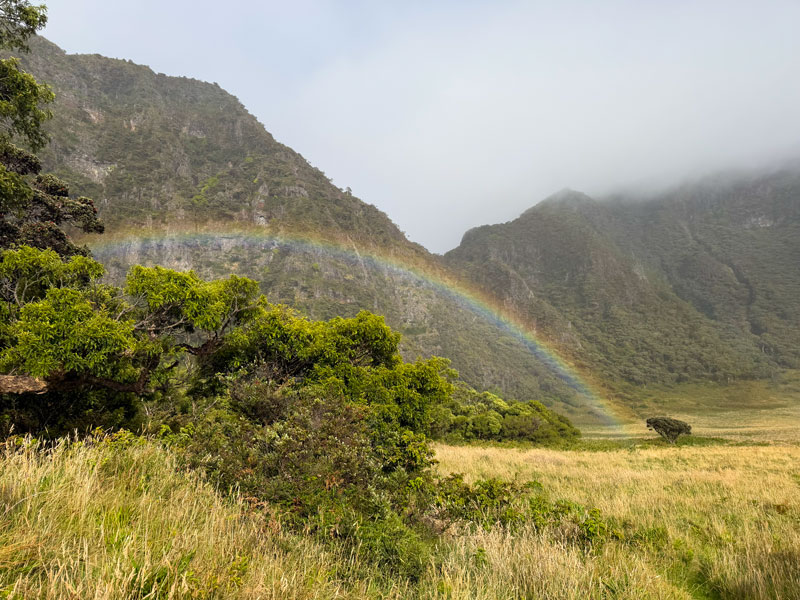
We were literally camping by a rainbow. How magical is that? The only thing that would have been better is if the wild nene, Hawaii’s native geese, would have stood right in front of it for me. They don’t listen to me. You will find these pretty geese at each campsite and at other points along the way. We liked to imagine they were our pets when we found them just outside our tents in the morning.
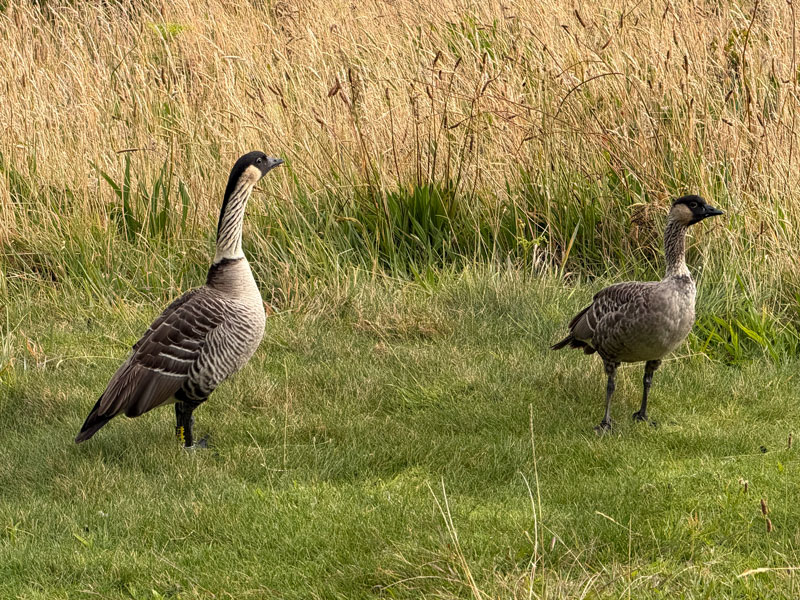
There is another cabin at Palikū as well as a ranger cabin and corral. This corral, along with places to tie up horses along the trail, suggested the rangers patrol by horse, though we didn’t see any.
Campsites
A sign at the cabin points to the left for the campsites. There was no map, so we wandered around to try to find the group site, which was number 5. We only found the campsites labeled 1 and 2 (marked on the map below), but we did see some other flat spots for a tent. Pretty sure we never did find the group site, but it was just as well because we were the only ones camping there that night.
Water The water spigot is located between the cabin and the campsites, and has a warning sign stating that it’s non-potable. Bring a filter for the water.
Toilet The toilet is located behind the cabin, and it has a sign warning that it’s unmaintained. It’s everything you’d imagine a backcountry toilet to be, spiderwebs and all.
Rain People warned us that it “always rains” at Palikū, and while the general forecast for the area showed only 20% chance of rain that day, it rained all night. As soon as the sun went down, the clouds rose up from the ocean and stayed until after the sun came up the next day. This meant we ate in our tents and spent a lot of hours in there to try to stay dry. We couldn’t help but think of those guys with their steaks and dry cabin. Bring a waterproof layer!
Kaupo Gap
If you have the time and inclination, you can do a day hike from Palikū down the Kaupo Gap Trail. This trail is maintained by the park for the 3.7 miles to the park boundary, so explore as far as you’d like, then turn back. We explored about a mile, and we saw nice ocean views as well as some interesting ferns. All the vegetation was wet from the rain, so that meant wet pants and soggy shoes from trudging through the dense flora.
Halemau’u Trail
Leaving Palikū, you’ll retrace your steps past the junction with the Kaupo Gap Trail to the next junction about 1.3 miles back up the trail. This time, instead of heading back toward Kapalaoa Cabin, you’ll fork right on the Halemau’u trail toward Holua.
You’ll have to gain some elevation now as you head back toward the main crater with lots of sharp lava flow formations surrounding you.
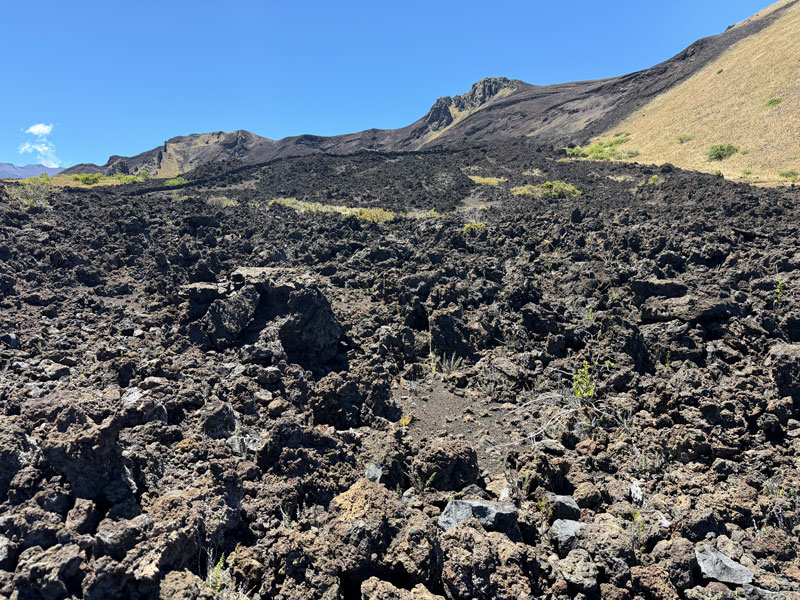
As before, there’s little to no shade, although we each managed to find a small shrub for a tiny bit of shade during lunch.
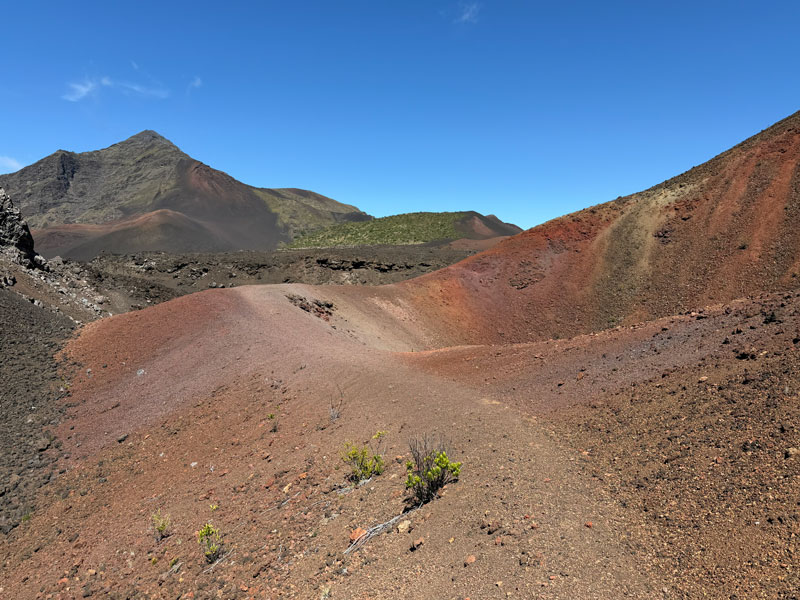
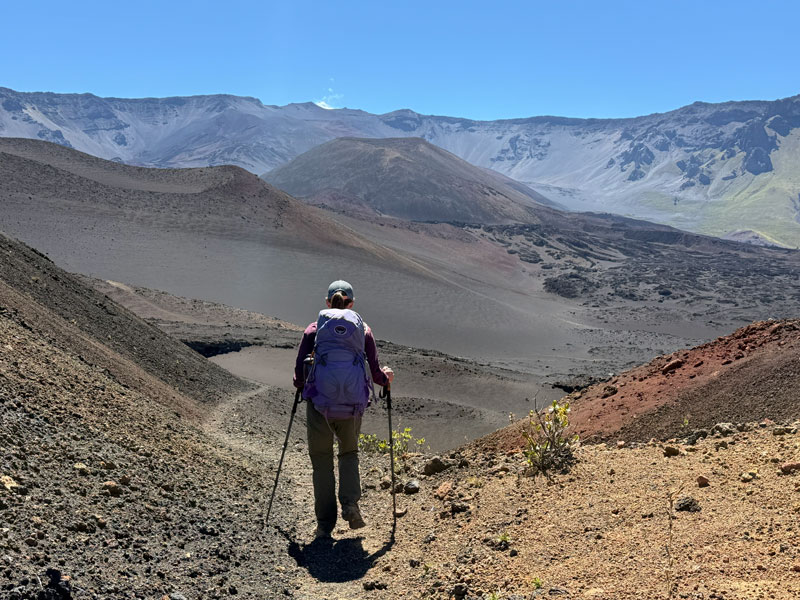
As you re-enter the main crater, the landscape begins to look more like you’re on the moon than Earth. Cinder cones tower above, and piles of ash are strewn in a kaleidoscope of colors about you. This was easily my favorite part of the journey, although the pictures just can’t seem to convey how special it really was. We tried.
Kawilinau Gulch (Bottomless Pit)
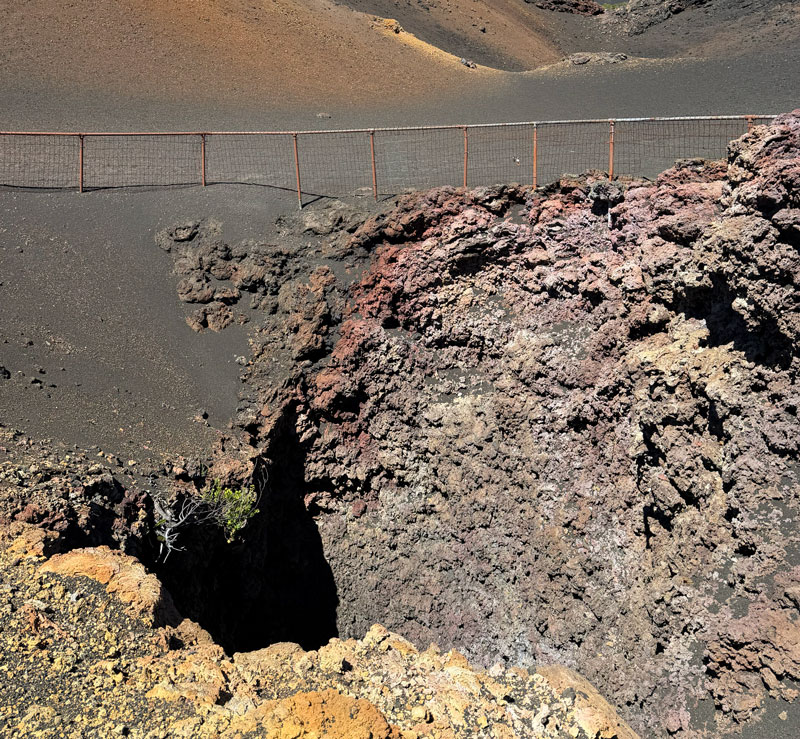
Along this section, you’ll also come across a fenced off volcanic pit called Kawilinau, or Bottomless Pit, as it has been known historically. This pit is 65-feet deep, so you won’t be able to see the bottom.
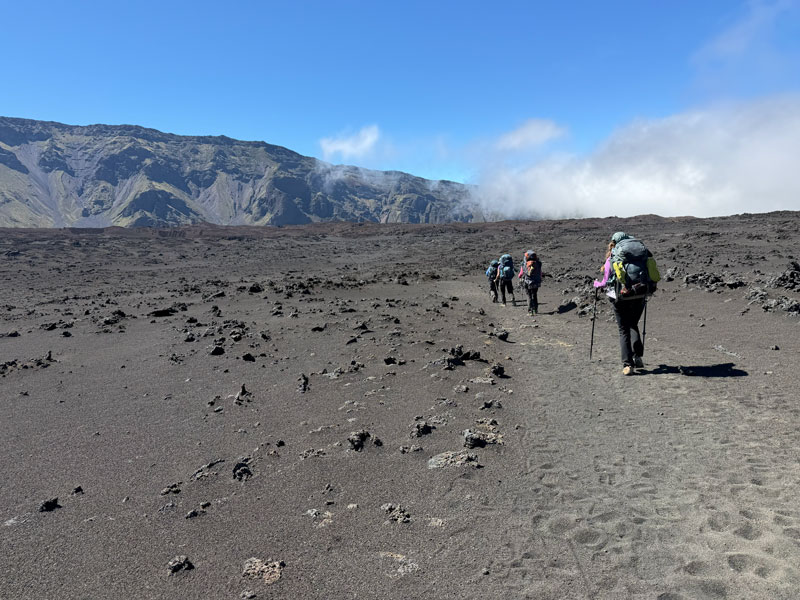
Continuing toward Holua, you’ll cross another expansive ancient lava flow to reach the other side of the crater. It doesn’t look like much in pictures, but it’s awe-inspiring.
Silversword Loop
Part way across this lava flow, you’ll see signs for the Silversword Loop. Yes, we did see silversword plants here, but honestly, we saw more on the way down the Sliding Sands Trail. It doesn’t add that much distance, so go for it if you’re a big fan of the plant, but it’s probably fine if you skip it.
As you approach the side of the crater, you’ll see the Holua Cabin in the distance.
Holua
From the cabin, you’ll head left up the hill toward the campsites (unless you’re lucky enough to have a reservation at the cabin). There is an obvious water spigot and toilet near the cabin, but the main water catchment and another toilet are located up the hill, so you won’t have to trek all the way back down here.
Campsites
This time, we felt like we knew what we were doing a little better, and we continued past the campsites marked 1, 2, 3, and 4 to a large unmarked campsite at the end that we realized must be the group site. The sites are grassy and close to the trail to the left or right, so you shouldn’t have trouble locating them.
Water The water catchment for Holua is next to the campsites behind a fence. A bathtub is there to catch any overflow when you fill your containers, but since a couple nene were swimming in it the next morning, I’d only use that water in a dire emergency.
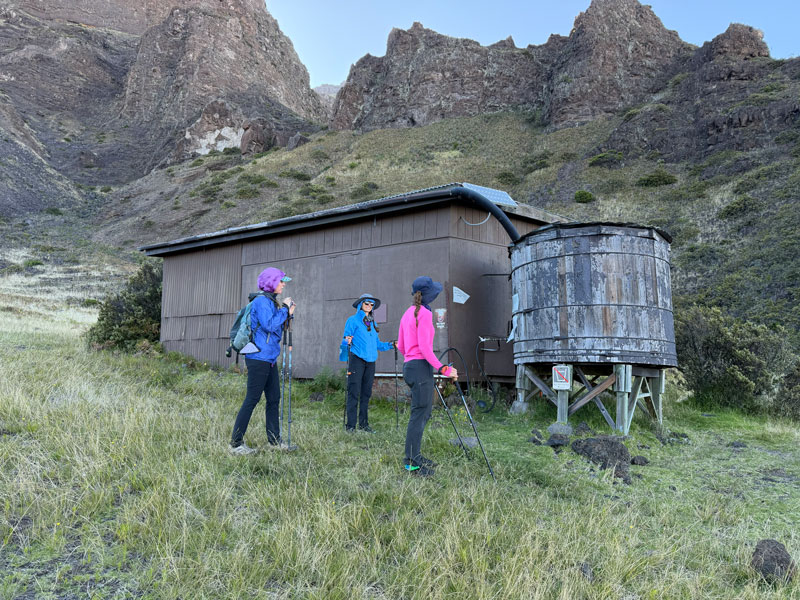
There are two valves on the hose – a white plastic one that only turns from an open to closed position, and a metal valve that you twist to turn on (counter-clockwise). A kid that was camping close to us figured it out, so you can too. Again, filter all water you get here.
Lava Tube
One of the special places near Holua Camp is a rather long lava tube that’s fun to explore if you have the time. All the information we had was that it was “a five minute walk south of the cabin.” Well, the campsites are south of the cabin, so I wasn’t sure where to begin. I decided to head to the cabin first to see if there was some sort of social trail that started there. Luckily, a nice man who had been there 50 times before offered to guide us to it. There is a faint trail leading up to it, but it can be tough to find at first.
Once inside, you can go for quite a distance, and you will definitely need a headlamp!
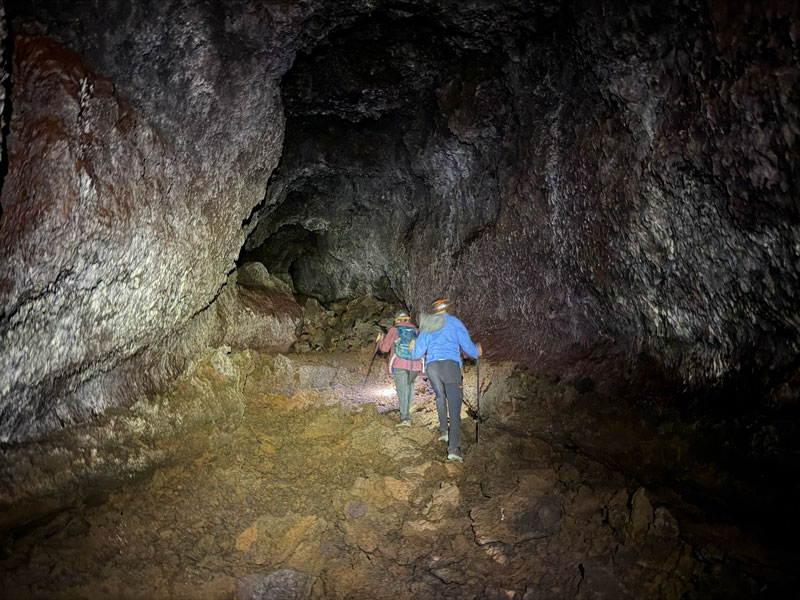
As a bonus, there were several guys inside the lava tube with ukuleles who serenaded us with a song in Hawaiian. It added even more magic to an already magical trip.
Because this is a wild cave, and a special place that needs to be protected, I won’t share the exact location. However, if you’re up for the challenge, please note that these environments are fragile and irreplaceable. Be respectful, stick to the trail that has been established by others, and LEAVE NO TRACE.
Halemau’u Trail
After a starry, dry night at Holua (which others had said was rainy the night before), we headed back toward the cabin to rejoin the Halemau’u Trail on its journey back to the rim.
The total distance from Holua to the rim is 3.7 miles, but the first mile is relatively flat as you finish crossing the lava flow. Up ahead, you’ll see those switchbacks on the mountain. Ah yeah, it’s about to get real! For the final 2.7 miles of the hike, you’ll be going up 1300 feet of elevation with great views along the way to reward you for your effort.
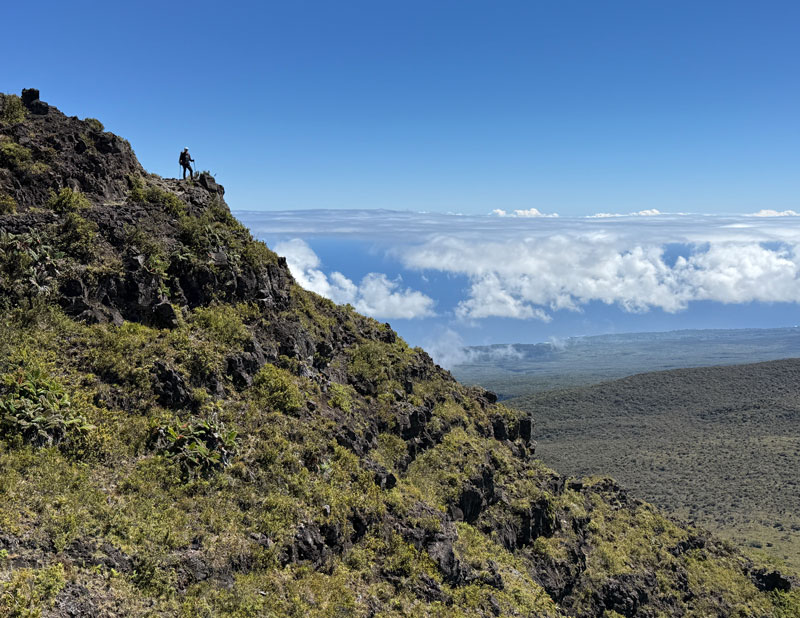
Yes, that’s the ocean in the distance!
There are a few great places to stop for a view and a picture where you’ll have massive views into the crater on one side and massive ocean views through the Ko’olau Gap on the other. When you cross the narrow ridge that’s locally known as Rainbow Bridge, you’ll know you’re almost there.
The last little bit of the trail is not that scenic as the ocean views sink behind the bushes, but the good news is that once you’re at your car, you’re just an hour away from shave ice.
Permits
You will need a permit for each night you spend in the crater. Permits are available on Recreation.gov.
Cabins There are 3 cabins available to rent: Kapalaoa, Palikū, and Holua. We didn’t have the cabins, but others told us that demand for the cabin permits is very competitive, so you need to reserve them six months in advance at the very moment they are released for sale.
Campsites There are two campgrounds: Palikū and Holua. Each campground has four individual campsites with a 4-person maximum and one group campsite with a 10-person maximum. There seemed to be availability even last minute for the campsites. We were the only ones using the campsites at Palikū, and while we did have neighbors at Holua, it looked like there were still some available. They can sell out, though, so be sure to reserve your campsite as soon as you know your dates.
Hosmer Grove Hosmer Grove is a car camping campground that was convenient for us to use the night before our trip. This way, most of the drive up to the crater is done, and you can visit the summit for sunrise if you’d like. There are six sites available, and only one other group was there the night we camped, but definitely make your reservations as soon as you can.
Food Storage
One of the best things about camping in Hawaii is that there are NO BEARS. No offense to the bears, but it’s a pain hanging up a bear bag or hauling a bear canister. We didn’t even bring rat sacks to protect from rodents, believing the only thing we would see is nene. Fences around the park generally keep mammals out. However, there was a notice at the campground that rat poison was being used, so take that for what it’s worth.
Water
The campsites and cabins rely on rainwater catchments for water, which means they have the potential to run dry in times of drought. It’s always smart to check with a ranger ahead of your trip to make sure you will be able to get the water you need. If no water is available, you will have to carry all the water you will need (huge bummer).
Map & Directions
Location Haleakalā National Park, Maui, Hawaii
Google Maps Keonehe’ehe’e Trailhead (Sliding Sands) and Halemau’u Trailhead
Fees/Passes There is a per vehicle entry fee to enter Haleakalā National Park, or you can use your America the Beautiful Pass. In addition, you will need a backcountry permit for each night you are spending in the crater.
Trailhead Facilities There are restrooms at both trailheads. There is sometimes water available at the summit visitor center, but it can experience disruptions. Your best bet is to stop at the main visitor center lower on the park road and fill up there.
Recommendations for you
Alice Toxaway Loop | Sawtooths, Idaho
Clouds Rest and Half Dome | Yosemite, California
Weatherford Kachina Loop | Flagstaff, Arizona
Leave a Reply